Front-lit
Translucent acrylic faces with LEDs inside, so each letter face glows. A common choice when the sign needs to read clearly from across the street at night.

Channel letters are individual three-dimensional letters, usually aluminum with acrylic faces, lit from inside by LEDs. Front-lit letters glow through the face. Halo-lit, or reverse, letters throw light onto the wall behind them. Some letters do both. In New York City, an illuminated storefront sign typically needs a DOB sign permit plus a separate electrical permit filed by a licensed electrician. Arc does the design and engineering drawings in-house (stamped by a third-party licensed PE when the job needs it), coordinates fabrication and installation through Arc's licensed partners, coordinates the sign permit with the licensed applicant, and coordinates the power handoff with the project's electrician. Arc does not file permits or stamp drawings.
The right style depends on the facade, how the sign needs to read at night, and what the landlord allows.
Translucent acrylic faces with LEDs inside, so each letter face glows. A common choice when the sign needs to read clearly from across the street at night.
Solid metal faces with light shining out the back onto the wall, so the letters read as silhouettes with a glow behind them. The letters stand off the wall, and the wall finish affects how the glow looks.
Front-lit faces with a halo glow behind, for a layered look at night.
The same letter shapes without lighting, in metal or acrylic. With no electrical connection, there's no electrical permit. You still usually need a sign permit unless the sign falls under DOB's exceptions.
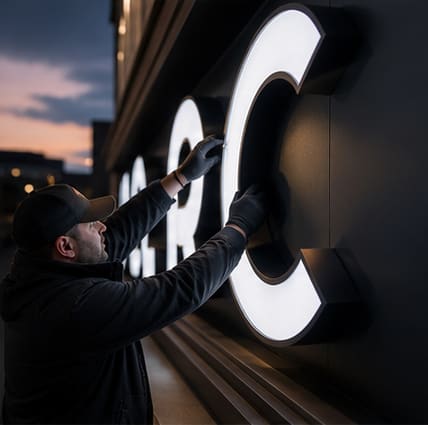
Letters are fastened to the facade one by one. This gives the cleanest look, but every letter needs its own attachment points and wiring path. So direct mounting depends on the wall, the access behind it, and landlord approval.
Letters mount on a narrow metal box that carries the wiring and power supplies. That means fewer wall penetrations and easier removal later. The raceway stays visible and is usually painted to match the wall.
Letters mount to a panel that is then fixed to the facade. Useful on uneven or delicate surfaces, or where the building's sign criteria call for a panel.
How Arc picks: the facade material, sign band, access, and landlord criteria usually decide the mounting method. Arc reviews them at survey and shows the method on the shop drawings.
Who files what: sign permits and shop drawings
Arc coordinates the power location, any timers or photocells the project specifies, and the handoff to the licensed electrician who files the electrical permit and makes the connection.
Facade photos, measurements, sign band, power location, and landlord criteria.
Layout options and shop drawings with letter sizes, materials, lighting, and mounting.
Permit and landlord coordination, plus LPC where the building is landmarked.
Aluminum returns, acrylic faces, and LED lighting, built to the approved drawings.
Install coordinated with a Licensed Sign Hanger and licensed electrician where required.
Email your files to jc@arcsignco.com with the project address in the subject line. Put URGENT in the subject for active jobsites.
Arc's 24-hour quote target starts once Arc has photos with measurements (or drawings, if you have them) and the project street address.
Request a quoteFront-lit letters have translucent faces, so the face of each letter glows. Halo-lit letters have solid faces and shine light out the back onto the wall, which creates a glow around each letter. “Reverse” and “halo-lit” usually mean the same style. Front-lit letters tend to read more directly at night, while halo-lit letters give a softer outline and depend on the wall finish behind them.
Generally, yes. A non-illuminated wall sign of not more than six square feet does not need a sign permit (AC §28-105.4.5). Other signs, including illuminated and non-wall signs, still need one unless another exception applies. Zoning and LPC still apply. Illuminated letters generally need a sign (SG) permit plus a separate electrical permit. If an illuminated sign extends beyond the building line, an annual illuminated sign permit may also be required, which matters more for projecting signs than for wall-mounted letters.
A licensed electrician files the electrical permit through DOB NOW: Build and makes the connection. The NYC Electrical Code also requires electric signs made for installation in the city to be inspected and approved by DOB before installation (§600.3(C)). Arc is not an electrical contractor, so it doesn't file or wire; it coordinates the power requirements and the handoff with the project's licensed electrician.
Under Construction Code §28-415.1, a Licensed Sign Hanger must perform or directly supervise exterior sign installation. §28-415.2 exempts some signs, such as signs of 75 square feet or less that weigh 25 pounds or less. Arc coordinates with a Licensed Sign Hanger where one is required.
Yes. Many leases and buildings set sign criteria for size, placement, materials, and lighting. The Zoning Resolution also limits sign size and lighting by zoning district. A landmarked building or historic district needs a Landmarks Preservation Commission (LPC) permit, filed through Portico. Arc asks for the criteria at the start and designs to them.
Send straight-on facade photos with measurements if you have them, vector logo artwork, the sign band or storefront width, landlord sign criteria, where power is available, your deadline, and the street address. Email them to jc@arcsignco.com with the project address in the subject line. Arc's 24-hour quote target starts once Arc has photos with measurements (or drawings, if you have them) and the project street address.
Rules change. Confirm current requirements with the agency, the project's licensed applicant, and the electrician. Sources checked September 2026.
Email facade photos with measurements and your logo artwork to jc@arcsignco.com with the project address in the subject line. For a storefront sign, lit letters included, that's enough to quote. No photos yet? Use the quote form and Arc will tell you what's needed.